Beautiful Corruption: How the Internet Learned to Love Its Own Mistakes
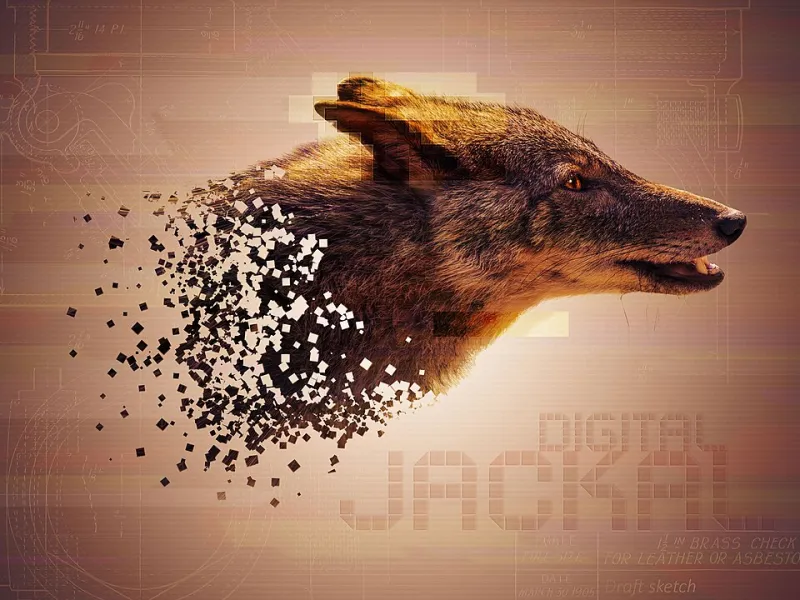
Photo: Arielinson, CC BY-SA 4.0, via Wikimedia Commons
There's a specific kind of image that stops your scroll cold. Colors that bleed sideways. Text that stutters across a frame like it forgot where it was going. A face split into horizontal bands, reassembled slightly wrong. You know it when you see it — and weirdly, you kind of love it.
Welcome to glitch aesthetics, the art movement that was born from a corrupted file and grew into a full-blown cultural obsession. What started as an accident became a signature, and that signature is now everywhere from gallery walls in Brooklyn to 15-second TikToks in the Midwest.
Static Was Always Talking to Us
The roots of this go further back than most people realize. Long before anyone was deliberately breaking their JPEGs for artistic effect, the visual language of malfunction was already embedded in American pop culture. Television static, VHS tracking errors, the way a rewound tape would ghost the same frame across itself — these were the original glitches, and they carried emotional weight even then.
Horror filmmakers understood this intuitively. The static that opens Poltergeist, the degraded footage in The Blair Witch Project, the corrupted video in The Ring — all of it leaned on a simple psychological truth: broken signals feel haunted. There's something unresolved about them. They suggest a message that didn't quite make it through.
Early internet culture inherited that feeling and ran with it. The mid-2000s web was already a chaotic visual landscape — animated GIFs stuttering on slow connections, image thumbnails that loaded halfway and gave up, forum avatars compressed into abstract smears of color. Nobody called it art then. It was just Tuesday on a dial-up connection.
When Accident Became Intention
The shift happened gradually, then all at once. Artists in the late 2000s and early 2010s started doing something counterintuitive: they began deliberately inducing the errors that everyone else was trying to avoid.
Databending — the practice of opening image or audio files in programs they weren't designed for, corrupting the data in controlled ways — became a technique with its own community and vocabulary. Open a JPEG in a text editor, change a few characters, save it back, and you get something that looks like a fever dream painted by a malfunctioning printer. It was cheap, accessible, and produced results that felt genuinely alien.
Glitch musicians were doing the same thing with sound. Artists like Oval and later Death Grips built entire sonic identities around audio that seemed to be actively fighting itself — skipping, stuttering, collapsing. The chaos wasn't incidental to the art; it was the art.
Visual artists like Rosa Menkman started writing seriously about glitch as a theoretical framework, not just a technique. Her Glitch Studies Manifesto argued that errors reveal the hidden architecture of systems we normally take for granted. When something breaks, you see how it was built. There's a kind of radical transparency in malfunction.
Gen Z Didn't Invent It, But They Made It Fluent
Here's where it gets interesting for where we are right now. Gen Z didn't create glitch aesthetics, but they grew up so saturated in it that they internalized it as a native visual language rather than a niche art world reference.
The lo-fi aesthetic that dominated Tumblr in the early 2010s was already pointing this direction — grainy photographs, washed-out colors, images that looked like they'd been photocopied several generations too many. But TikTok accelerated everything. The platform's compression artifacts, the way videos degrade through re-recording and re-uploading, the deliberate use of distorted audio and glitched transitions — all of it got absorbed into a generational aesthetic vocabulary.
What's striking is why this resonates so deeply with younger audiences. There's a compelling argument that glitch aesthetics function as a kind of emotional honesty in a media environment defined by relentless polish. Perfectly curated Instagram grids, flawlessly lit YouTube setups, algorithmically optimized content that has been sanded down to remove anything rough or unexpected — against that backdrop, something visually broken feels real in a way that perfection no longer does.
The error becomes the signal. The corruption becomes the message.
The Commercial Absorption Problem
Of course, nothing stays underground forever, and glitch aesthetics have been thoroughly colonized by the same commercial machinery they originally felt like a rejection of. Fashion brands run ad campaigns with deliberately corrupted typography. Streaming services use glitch-style motion graphics for their true crime thumbnails. Spotify Wrapped used fragmented visual effects to make data feel edgy.
This creates an obvious tension. When the aesthetic of malfunction gets absorbed into the smooth machinery of corporate branding, does it lose the thing that made it interesting? Can something that was born from the edges of the internet survive being used to sell sneakers?
Most working artists in this space shrug at the question. Aesthetics get absorbed; that's just how culture works. What matters is whether the underlying ideas — about systems, about failure, about what gets hidden when everything runs perfectly — continue to generate interesting work.
And they do. Independent artists are still finding new territory in the space between signal and noise, still finding ways to make broken things say something that polished things can't.
What the Static Is Actually Saying
Maybe the deepest thing about glitch aesthetics is what they imply about our relationship with the technology that mediates almost everything in our lives. We live inside systems we didn't design and can't fully understand, and mostly those systems present themselves as seamless and inevitable.
A glitch is a crack in that seamlessness. It's a moment where the machine shows you its seams, its limitations, its fundamental weirdness. And there's something almost comforting about that — a reminder that underneath all the smooth interfaces and optimized experiences, things are actually pretty strange and contingent and held together with digital duct tape.
The internet has always been noisier than it looks from the outside. Glitch art just learned to turn up the volume on the noise and listen to what it was saying all along.
At ROUPNKW, that's kind of our whole thing.