Dial It Back: The Creatives Throttling Their Way to Better Work
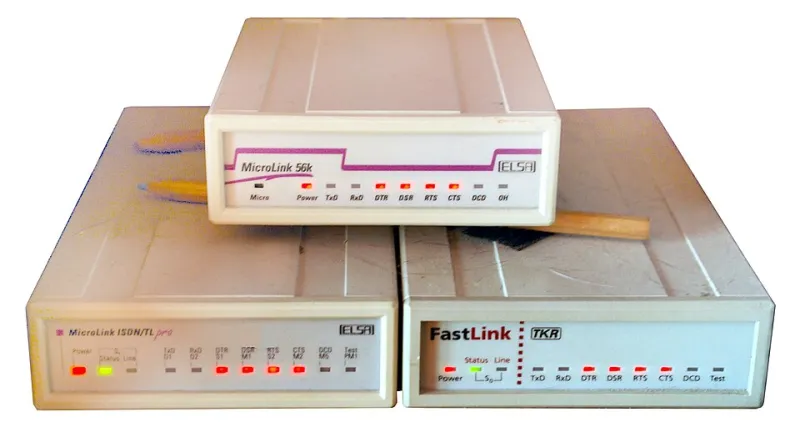
Photo: File:Elsa Modems IMGP0424.JPG: Johann H. Addicks - [email protected] derivative work: Pittigrilli, GFDL 1.2, via Wikimedia Commons
There's a specific kind of frustration that comes with a spinning loading wheel. Most people treat it as a minor tragedy — wasted seconds, stolen momentum, a tiny theft from the day. But a scattered and growing crowd of creative workers across the US has started to see that wheel differently. They're not suffering through the lag. They're scheduling it.
Welcome to the intentional slowdown. No, it's not a productivity hack your startup newsletter is going to celebrate. It's quieter than that, and considerably weirder.
Speed Was Never Neutral
Silicon Valley has spent the better part of three decades selling speed as an unambiguous good. Faster load times, faster feeds, faster everything — the assumption being that friction is failure and latency is the enemy of progress. Fiber optic lines snake under cities. 5G towers multiply like weeds. The pitch has always been the same: faster internet means more done, more created, more connected.
But some people are starting to ask what exactly is getting done. And whether "connected" has become a polite word for something that feels a lot more like "scattered."
A novelist in Portland recently described her process to a small writing forum — one of those semi-private corners of the internet that doesn't advertise itself. She throttles her home connection to something approaching early 2000s DSL speeds during her working hours using a simple router setting. Images load slow. Video is basically impossible. Tabs feel like commitments again.
"When a page takes eight seconds to load, you ask yourself if you actually need that page," she wrote. "Usually I don't. Usually I was just running from a sentence I didn't know how to finish."
That reframe — from inconvenience to information — keeps appearing in conversations about deliberate slowdowns.
The Bandwidth Budget
For developers and designers, the practice has taken on a slightly more structured form. Some are adopting what they loosely call a bandwidth budget: a self-imposed ceiling on connection speed that forces them to work in conditions closer to what a large portion of their actual users experience.
This has practical benefits that go beyond the philosophical. Apps and websites built under constrained conditions tend to be leaner, faster for everyone, and less bloated with features that exist only because the developer never had to wait for them. When you're the one sitting in the slow lane, you stop building things that assume everyone else is in the fast one.
But the creative benefits are harder to quantify and arguably more interesting. A UX designer based in Austin described throttling as "putting a cost on curiosity." Not a punishing cost — just enough friction that opening a new tab requires a half-second of intention. "I used to have forty tabs open and feel productive," he said. "Now I have five, and I actually am."
Retro Constraints, Modern Clarity
There's a nostalgia layer to this, and it's worth acknowledging without being sentimental about it. People who grew up with dial-up internet remember — whether fondly or not — that the wait was built in. You clicked a link and then you did something else for a moment. You thought. You looked out a window. The internet had natural pauses baked into its architecture.
Those pauses weren't bugs. For a lot of people, it turns out, they were features.
Some writers have gone further than throttling, building what they call "offline windows" into their schedules — blocks of time where the connection is cut entirely, not just slowed. This isn't new; the appeal of distraction-free writing tools has been documented for years. But the intentional lag approach is subtler. You're not offline. You're just... present in a different way. The internet exists, it's just not instant. It requires a small act of will to use.
That distinction matters psychologically. Full offline mode can feel like deprivation, which breeds resentment and the urge to binge once the block ends. A slow connection feels more like... weather. You work with it rather than against it.
What the Static Teaches You
Here at ROUPNKW, we're interested in what lives in the noise — the signals that don't arrive clean and bright and optimized. Slow internet is a kind of static. It resists the algorithm's preferred mode, which is frictionless consumption. When everything loads instantly, the path of least resistance is always to consume more. When there's a small tax on every click, the math changes.
A musician in Chicago who records ambient electronic music talked about using throttled internet during composition sessions specifically because it changes how she researches. "I'll have an idea, type something into a search bar, and then while it loads I'll just sit with the idea a little longer," she explained. "Sometimes by the time the results come up, I've already gone somewhere more interesting on my own."
That's the counterintuitive gift buried in the lag: it creates a tiny gap between impulse and information. And in that gap, something can happen. A thought can develop. A direction can clarify. The static, paradoxically, clears something up.
Against the Optimization Gospel
None of this is going to disrupt the infrastructure industry. Telecom companies are not pivoting to "premium slow" plans anytime soon (though honestly, given the way creative communities operate, never say never). The intentional lag movement — if it can even be called that — is personal, practical, and deliberately low-profile.
But it pushes back against something worth pushing back against: the idea that every problem in creative life is a speed problem. That if you could just load pages faster, process information faster, ship work faster, everything would improve.
Some things improve with friction. Some ideas need the lag to form properly. Some creative work happens not in the instant of connection but in the half-second before it — in the small, quiet moment when your brain is still on its own.
Slow your connection down. See what shows up in the gap.
It might be the best thing you make all week.